

The year I was twelve, we spent Christmas near a village in the province of Esmeraldas, on the northern Pacific coast of Ecuador. At the time, there was no land route from Quito, which sits high up in the Andes, so we parked our 1948 Dodge at the end of the stone-paved Inca highway and traveled the rest of the way by canoe—my parents and I and the three other members of my father’s string quartet. Some friends of my parents, a couple and their daughter, followed in a second canoe. The trip was my mother’s idea. All our trips were my mother’s idea.
The village was inhabited by the descendants of shipwrecked African slaves who swam ashore, conquered the native tribes, and established themselves in a swath of jungle bordering the ocean. The only white person in the village was a red-headed Italian priest.
We celebrated Christmas by drinking coconut water out of freshly-picked coconuts, sliced open with a single blow of a machete. In the mornings, we bathed in the tepid Pacific. One day, some frigatebirds flew overhead and we were warned not to go near the water, because the arrival of the frigates meant that there were sharks in the bay. On rainy afternoons the cellist of the quartet taught me to play canasta. It was hot and humid. The sun shone hazily through the flat gray sky over the flat gray water. Even the dense, matted jungle seemed more gray than green. All my memories of that Christmas are gray, but that may be because the black and white photos I’ve kept have faded.
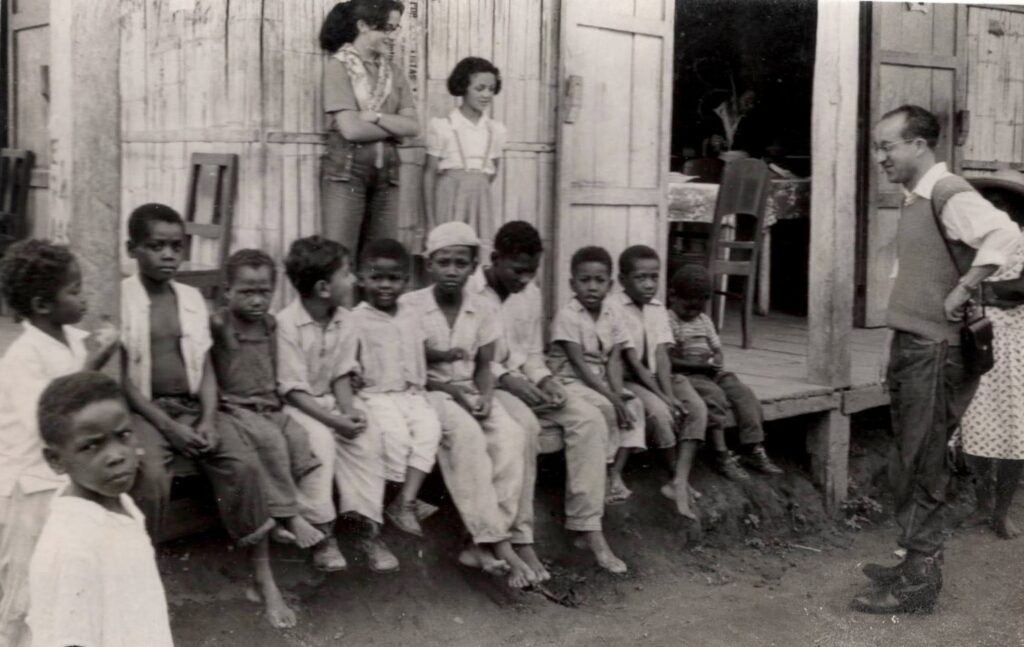
In the photo below, I’m standing on the porch of our cabin with the daughter of my parents’ friends. She was an only child, like me, and she had to ask her mother’s permission whenever she wanted to take off her sweater. That was the first time I realized that there were other kids in the world with a fate similar to mine. In the photo, the quartet’s viola player, smiling and holding a camera, faces eleven little boys. Who were those little boys, and why were they lined up on our porch? Why were there no little girls? I can see a bit of a woman’s skirt at the edge of the photo, probably the school teacher, who had brought her class to see these weird visitors from another world.
All that week it was hot and it rained, it rained and was hot. I got pretty good at canasta, fell against a barnacle-studded rock while wading and bled profusely. Then, on New Year’s Eve, the priest told us not to go into the village, and to stay close to the house. As soon as the sun went down, the drumming started in the jungle behind the cabin. In the darkness of the tropical night, accompanied by the chirping of millions of insects and the occasional jaguar screech, that drumming transported me to the heart of Africa. I felt like Deborah Kerr in King Solomon’s Mines. It went on until dawn, without a pause.
The next day, it was time to return to Quito. In the eerie silence that followed the drumming we packed our bags and boarded the canoes. No sooner had we settled in than the rain began. It poured steadily during the four-hour trip, which we spent bailing water with empty coconut shells. The river was raging, all brown water and white foam, and the engine could barely keep up against the current. None of us knew how to swim. There were no lifesavers on board. My mother was sure that we were going to die.
Today, if you want to go to Esmeraldas, you no longer have to travel by canoe. There is a highway now, and an airport, and a big harbor. Tourists are warned to be “prudent” and on the lookout for drug gangs. And the “Afro-Ecuadorean” music festivals have become big business.
2 Responses
You have such fascinating memories – and your mother was a force of nature, corralling all those people to go on such a trip!
And then worrying about you all drowning. What a vacation to have gone on.
She was adventurous, and then would freak out—often with good reason.