

This is the time of year when my mother would take me to Barcelona’s Gothic Quarter. On December 13, the feast of Saint Lucy, the Christmas Fair opened next to the walls and buttresses of the cathedral. We went to get supplies for our Nativity scene: fresh moss to simulate meadows, tree bark to make into mountains (with a sprinkling of flour for snow), and one or two little clay figures to add to the wise men, angels, sheep, goats, hens, shepherds, and assorted hangers-on that populated our version of first-century Palestine.
There was one figure that my parents were too squeamish to allow, despite its deep roots in Catalan tradition: el caganer—a man in Catalan folk costume, squatting with his pants down, doing his business.
But before we hit the Fair, we would go into the cathedral to see the geese. I don’t know how many cathedrals have geese in their midst, but Barcelona’s Cathedral of Saint Eulalia has a whole gaggle of them. My mother explained that the geese numbered thirteen in honor of Saint Eulalia, the patron saint of Barcelona and my patron saint as well, who was buried in the crypt under the cathedral and who had been thirteen years old when she was martyred by the Romans.
It would have been bad spiritual manners to go straight to the geese, so first we used to stop before the main altar to pray. Already as I knelt there, with the grit from the kneeler digging into my bare knees, I could hear them, their cries echoing against the stones. I would look up at my mother, “Can we go now?” My mother would respond by closing her eyes and praying some more. She knew the art of sharpening anticipation.
Eventually we would rise, make the sign of the cross, brush the grit from our knees, genuflect as we passed the altar, proceed in a dignified manner to the holy water basin, dip our fingers, make another sign of the cross, and come out into the cloister.
Before I even saw the geese, I would be overcome by the charm of the cloister—a space that was neither indoors nor outdoors, where light and sound bounced oddly among the stone arches and the potted palms and orange trees, a space that spoke to me of beauty for its own sake in the midst of the serious business of religion. A space that had geese.
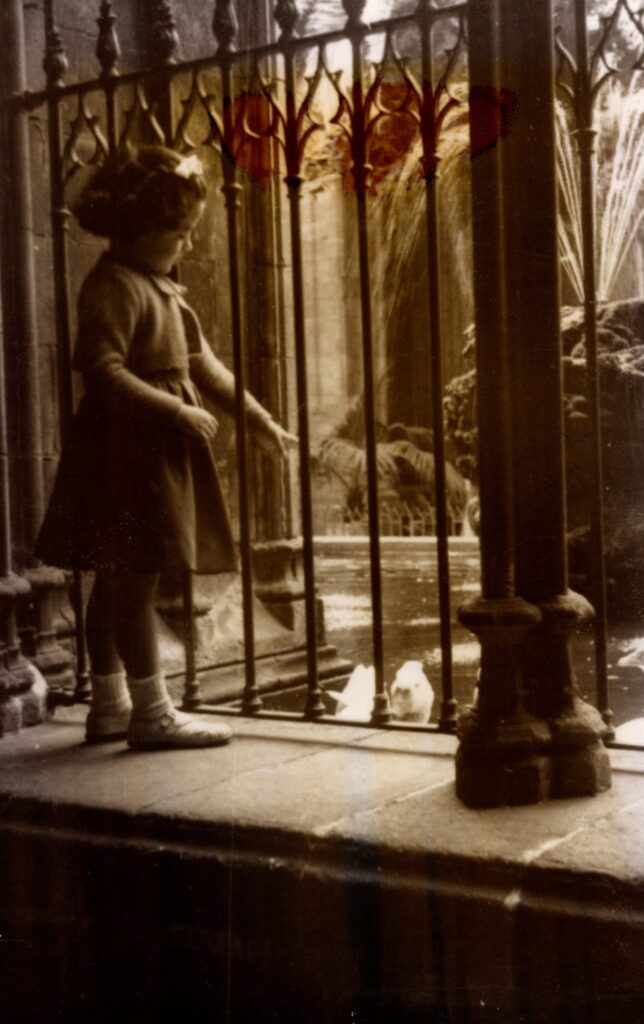
In the middle of the courtyard there was a large stone platform surrounded by an iron grille. In the center of the platform a moss-covered fountain trickled water into a basin. And that’s where the geese were, white and majestic, honking and waddling around on the flagstones, then gliding into the basin and floating around, looking pleased with themselves.
Those geese, in the center of the cloister, in the middle of the bustling city, were a miracle to me. I was enchanted by their orange beaks and feet, their scandalous green droppings, and their serene disregard for the holiness of the place. They were warm, alive, and untamed, irreverent and perfect. They were for me, and they still are, the beating heart of the city where I was born.
10 Responses
Best use of “scandalous” ever!
As children will, I found those green droppings fascinating.
Oh my gosh… Adorable child. (“Serene disregard” pretty perfect, too.)
I was trying to have an I-Thou moment with the goose.
And the beautiful description of a place that is magical in part because of being neither indoors nor outdoors.
There is nothing like a cloister, IMHO.
No equivalent stories with animals – mine was a boring life.
So was mine…punctuated by moments of high excitement.
What a precious photograph, Lali. So glad your parents and relatives took so many photographs of your childhood!
This is one of the very few in which I am not squinting into the Mediterranean sun.