
My mother, like Don Quijote, used to read a lot of novels, and sometimes they went to her head. At one point in my infancy, she read that a broad forehead was a sign of noble character and possibly of high intelligence. Fortunately for her, both her face and mine featured a wide expanse of skin between hairline and eyebrows, and she determined to make the most of it.
She had lovely, wavy, abundant hair, but you would hardly know it from her photos, so severely did she pull it back lest it compromise the dimensions of her brow. She managed this not with hairbands or bobby pins, but with a small, curved comb which she would rake through the hair above her forehead and then push sharply forward to set it in place. I can still see her making that gesture, which used to strike me as a manifestation of her assertiveness and determination. I never figured out how those combs stayed put even on windy days, but they obeyed her.
As for me, photos of my toddlerhood show me with every strand of my rebellious front hair pulled back and subdued with a large ribbon bow, exposing a brow fit for a king. Those red or white satiny ribbons, so quick to wrinkle, so ready to slither off and disappear, were one of the banes of my childhood, along with errant socks, handkerchiefs, and gloves.
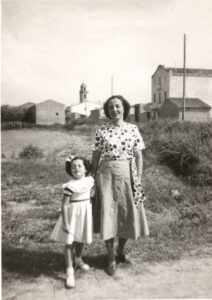
Here we are, my mother and I, standing across from my grandparents’ farmhouse, the Mediterranean sun bouncing off our noble foreheads. (In the background you can see the village church whose bells measured out the hours of my childhood summers.)
I wore bows in my hair until puberty. I might have been able to get rid of them earlier if I had had a slew of siblings to keep my mother busy, but I was an only child, and few things distracted her from her laser-like focus on me. As the hormonal tides began to surge, though, and I spent hours scrutinizing my looks in the mirror, I began to suspect that prettiness was perhaps more desirable, at least where the opposite sex was concerned, than nobility or intelligence. When I started letting a wave here and there cast a shadow on my facial piazza, at first my mother kept brushing it back (“Let me see your eyes! I can’t see your eyes! God gave you nice eyes. Why are you hiding them?”). But as the years wore on she either tired of this or decided to pick her battles.
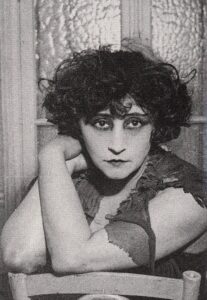
In my twenties, in graduate school, I was reading Colette. She, it turns out, also had a wide and spacious forehead—what she called “un front masculin.” Unlike my mother, she wasn’t proud of it, and she hid it under a mass of curls, especially as she aged. A mature face, like a ripe fruit, she wrote, needs some “foliage” around it.
Inspired by her, I covered my brow with bangs, but I failed to notice the irony: like my mother, I was letting literature influence my hairstyle.
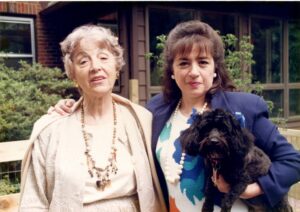
I never spoke to my mother about the noble forehead controversy. But gradually, over the years, she started allowing some wispy bangs to frame the sweet fruit of her face. Here we both are, she in her late seventies, me in my fifties, both our noble foreheads shrouded in some much needed foliage, at last.
8 Responses
Such a pleasure to read! It brought back memories of the great debate(s) about cutting my braids for what I thought was a more “mature” style (at age 8!).
Amazing that you were so self-aware at that age.
I can relate!
My mother pulled my hair back in a ponytail so tight it hurt!
Yikes! And now we’re all cautioned not to do that lest it never grow back.
Missed you this week, but now I have this lovely story!
Thank you! I hope you’re basking in warmth both physical and emotional.
Hair was a main issue with my mother. I wanted to let my hair grow and have pigtails. She said I could have long hair when I no longer lived under her roof. So–as soon as I left I let my hair grow and grow, of course.
Hair and mothers, mothers and hair… 🙂