

It seemed like an age appropriate thing for me to do, so last weekend I participated in the Great Backyard Bird Count. For each of four days I spent ten minutes at the window by our bird feeders, recording any birds I saw. You would think that with a menu of sunflower seeds and berry-enriched suet, plus a birdbath, our yard would be bursting with birds. But no. On any given day I would only see five or six birds max, and on the last day I saw none at all.
There is something about bird watching that arouses competitiveness in even the mildest of souls. We’ve all heard about dignified elders coming to blows over their bird lists. It turns out that I am no exception. I stood at the window with the timer going, tapping my foot. Where were the cardinals, the song sparrows, the bluebirds, the waxwings—all the “interesting” or at least brightly-colored species that had visited me in the past? Now that I wanted to count them, they were nowhere to be seen.
Bitterly, I figured they were all at the neighbors’, whereas I only got the dullest and grayest: nuthatches, titmice, a single chickadee. I got excited when a junco showed up, pecking at the seeds on the ground, elegant in dark gray and white plumage, and with that perfect yellow beak. If I still had my sewing machine I would make myself a gray and white dress with yellow piping around the neckline.
As if the dearth of birds weren’t bad enough, I berated myself for my impatience. I remembered Jane Goodall, who followed a troop of chimpanzees for months through the jungles of Gombe before they allowed her to come close enough to observe them. And I thought about Sooyong Park, a Korean photographer who lived five years in the Russian forests filming the elusive Siberian tiger. At one point, half starved and almost frozen, having gone eighty days without a glimpse of a tiger, he became entranced with the beauty of the falling snow and started filming that—and was rewarded with the appearance of three tigers, a female and her cubs.
Inspired by Park and Goodall, I decided that as long as I was stuck watching for ten minutes, I would look at the trees. They had been waiting for me to notice the varied texture of their trunks since they shed their leaves back in October. I would look at the highways that the squirrels had carved in the snow between the trees and the birdbath. And I would attend to the squirrels, who, unlike the birds, appreciate my yard, with its offerings of water and seeds. In return, they provide hours of entertainment to the cat Telemann, who loves to slam against the glass as they drink. (Only the young ones flee. The older ones know he can’t get at them, and pay no attention.)
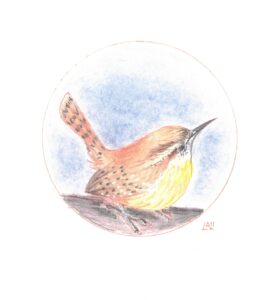
I was noticing the trees and the squirrels, and not thinking about birds, when the Carolina Wren appeared—busy and lively and very hungry. “All that is round invites a caress,” Gaston Bachelard wrote, and can there be anything rounder and more caressable—if he would only hold still—than a wren with his little ping-pong ball of a body and his perky cantilevered tail? As an experience, seeing the wren couldn’t compare with observing chimps in Gombe or filming Siberian tigers, but what could I expect? I hadn’t spent years sweltering in the tropics or freezing in the tundra to deserve those prizes. I had merely spent forty minutes over four days gazing comfortably out of my double-glazed window. That Carolina Wren was perfectly proportioned to the effort I’d expended.
(I wrote about Sooyong Park’s experience here . His five years in the forest, which left him so weak and wasted that he could barely walk, yielded unprecedented footage of Siberian tigers in the wild. You can see the documentary here.)
4 Responses
You provided data – that’s the part you should be happy about.
If there weren’t any, there weren’t any!
When we first moved here (Aug. 2018), the pigeons drove me crazy with their cooing. During the pandemic they disappeared. They haven’t come back.
Every time I see a bird when I open the blinds in the morning, I thank God we still have some.
I wonder where those pigeons went?
Delightful! I laughed out loud as I was experiencing much the same frustration just up the road from you, and the infrequent Carolina wren visitor didn’t even make an appearance. Glad he/she showed up for you, Lali!
I wish I could tell if that wren is one or two wrens, so I could look forward to wren babies in the spring.