
I wasn’t introduced to television until I came to the U.S. at fourteen, and I used to think that those TV-free years somehow had inoculated me from that curse of the present age, screen addiction. So it was a revelation of sorts when my Kindle died a couple of weeks ago and I went into withdrawal. My Kindles have always been a miracle to me. I got the first one twenty-two years ago, when I was living in the wilds of southern Vermont, a forty-five minute drive from the nearest bookstore. Our little village had converted the old school into a library—an airy, light-filled space with floor-to-ceiling windows. Unfortunately, those windows left little room for shelves, and the collection was too small to sustain my reading habits.
Then my first Kindle arrived and changed my life. In the middle of the night, in a raging blizzard, I could, without even getting out of bed, summon almost any book in the world—some, such as the works of Austen or Trollope or Henry Janes, for only pennies. Yes, I felt bad about abandoning that distant independent bookstore, but the Kindle had bewitched me.
Still, when my second Kindle died the other day, I thought that I would try to break the spell and go back to what some call “real” books. In addition to the contents of my own shelves, our retirement community has a well-stocked library a mere ten-minute walk from my house. Surely that would be enough to keep me going for a long time.
But a strange thing happened. For the first time in my life, I didn’t enjoy reading. I kept thinking about the poem by Mallarmé that begins, “The flesh is sad, alas, and I’ve read all the books” (La chair est triste, hélas! et j’ai lu tous les livres). I won’t bore you with details of the sadness of my flesh, but I definitely got the feeling that I had read all the books. I tried rereading the old favorites on my shelves, and thrust them aside with a yawn. I went to the library in search of something new, and everything I picked up felt flat and predictable. Was I losing my love of reading, and if so, how would I make it through the rest of my life?
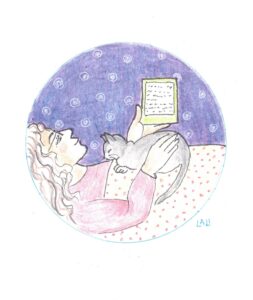
In addition to the boredom there was the physical discomfort of reading a book on paper. Accustomed to the Kindle’s adjustable font sizes, my eyes found the type fatiguingly small. Then there was the problem of holding the book open, which usually required two hands and made it hard to combine the pleasure of reading with that of eating and drinking. And at night, flat on my back with the cat Telemann crouched on my chest, no literary masterpiece could distract me from the strain on my forearms as I tried to hold the book aloft.
My resolve lasted an entire week. Then I caved and ordered a reconditioned Kindle, which took another week to arrive, by which time I was spending unconscionable amounts of time scrolling through Facebook. Now Kindle #3 is here at last, in a lovely pistachio-colored case. I’m reading a book that I got for under $2 because its copyright had long expired. It’s Practical Mysticism, which sounds like an oxymoron but isn’t. It was published at the beginning of World War I, and I thought it would be appropriate for the time we’re living in. I am not finding it the least bit boring.
(N.B., despite my Kindle addiction, I do not own Amazon stock, and I strongly disapprove of what Jeff Bezos did to The Washington Post. I also deplore his wife’s outfits and her, in the words of The New York Times, “cantilevered breasts.”)
3 Responses
Yes, “Practical Mysticism,” written in 1914, is the perfect book for 2026. An excellent find – good for Kindle!
Have you read it?
It was not their primary intent, but Amazon has made my life in many ways infinitely easier – as an ill and disabled person, real stores are an absolute horror of blocked aisles and irritating people.
In addition, they are my publisher and distributor – and I need them.
Bezos has let fame and fortune go to his head, alas – there must be something in the water billionaires drink.