

“Want to know how to get a year’s supply of meat for free?” my friend asked. Did I ever! Fresh out of graduate school, my husband and I had bought our first house, and were paying what felt like enormous sums to keep the children in daycare while we worked at our first jobs. “You buy two three-day-old bull calves,” my friend explained. “They cost next to nothing because the dairy farmers don’t want them. You feed them for eight weeks on milk replacer, then you have them slaughtered, sell one, and basically eat the other one for free.”
I was captivated. (This was many years before I became a vegetarian.) Our house sat on less than two acres, but it had a large vegetable garden, an orchard, and two chicken coops. One of the coops was large enough to house the calves—my friend had emphasized that they must on no account be let out on grass, or their flesh would lose its prized pallor. All I needed was some wood shavings for bedding, a sack of powdered milk replacer, and two big buckets in which to serve it. What could possibly go wrong?
It was early summer, and cows were calving. We located a farmer who had two Holstein bull calves he was happy to sell us. They were each about the size of a German Shepherd, light and docile enough that we could easily load them into our VW bus and take them home to their chicken coop. I named them Ambrose and Jerome.
All went well, until they came down with a case of diarrhea. Knowing how deadly that can be for infants of any species, I consulted the vet, who gave me some enormous pills and instructed me to jam them down the calves’ throats. While the pills were doing their work, I came across a Dept. of Agriculture leaflet that said that the mortality rate for calves separated early from their mothers was 50%.
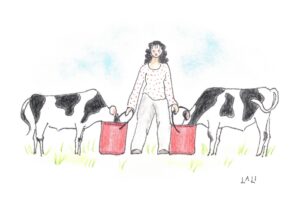
Happily, Ambrose and Jerome seemed determined to defeat that statistic. Not only did they get over the diarrhea, but they grew at an alarming rate. At feeding time, I would set two big red buckets down by my feet and hold them while they drank. But if you have watched baby herbivores nurse, you know that they stimulate milk flow by butting their mother’s udder. When the level of milk started to go down in the buckets, Ambrose and Jerome, wanting more, would begin butting my knees. The fact that their efforts were unproductive only made them butt harder.
 You wouldn’t believe how fast a Holstein calf can grow, or how much manure it produces. Between the trauma to my knees and the shoveling required to keep the chicken coop pristine, I began to think that I might not live to enjoy the promised supply of free meat. But the eight weeks were almost up, and I made an appointment at the slaughterhouse timed to coincide with my summer break and the last of the milk replacer. My husband would take a vacation day, and the girls would be in day care.
It would all have worked out if it hadn’t been for the hurricane. The morning of the appointment it was gusty and raining cats and dogs, with more on the way, and day care was cancelled. We would have to take the girls with us. We installed them in their car seats in the VW bus, handed them some picture books, and told them we’d be right back. Then we went to get the calves.
We opened the door to the chicken coop and Ambrose and Jerome sprang out into the storm. Their hooves had never touched earth before, so when they landed they took off curvetting and cavorting for all their worth. My husband and I ran after them, but we kept slipping and falling in the mud until it occurred to me to fetch the red buckets. That got the calves to follow us, but the next problem was to get them into the VW, on the floor of which my husband had thoughtfully spread a layer of clean wood shavings. “Are the calves coming to school with us?” the girls wanted to know. But there was no way that, fit and young as we were, we could heft those enormous Holsteins into the vehicle.
Finally my husband splashed his way into the basement, splashed out with a piece of plywood to use as a ramp, and we managed to shove the calves in. The wind was fierce, and the bus sashayed all over the road as we drove to the slaughterhouse. We arrived and the butcher came out, a giant of a man in a blood-spattered apron. We slid open the bus door to reveal Ambrose, Jerome, and the girls, and the man let out a guffaw, “Awww! ” he said. “Look at the babies on their cute wood shavings!”
He picked up the calves one at a time and disappeared, and we hightailed it back to civilization. A few days later we returned to pick up two boxes of neatly packaged veal cuts. A friend got Ambrose, and we kept Jerome. His meat was pure white, but also tough and dry. But at least it was free.


9 Responses
It wasn’t free – you paid with an enormous amount of labor! And worry. And milk replacer.
I’m not a vegetarian – I’m on a low-carb diet, and eat a lot of meat and dairy products.
But I didn’t grow up on a farm, and I need that mental separation humans do when they are going to eat the cute babies of another species.
Not free at all–I was being ironic. 🙂
For years I’ve loved the way you write, reaching deep into our humanity through fine storytelling.
Thank you for this special recollection and inside-info about farming-life, new to me.
And thank you for sharing so much of your wondrous life, Libby
Thank you, Libby. Coming from a writer like you, your words mean a lot.
I was married to a dairy farmer for many years and I well remember bottle-feeding calves and loved having them suck on my fingers! More power to you, Lali!
Our poor little calves never got bottles–they just drank out of a bucket. I was beyond ignorant in those days.
I was afraid you were going to say the girls cried “You’re not going to kill Ambrose and Jerome?!!!” (Along the lines of Fern asking “Where are you going with that axe?” And we know where that led.) Whew.
I thought surely this story was going to end with your inability to kill the calves. Very sad and no wonder you are now a vegetarian.
Well, it was either them or me. Plus no way they would have fit in the chicken coop as full-grown bulls. But I’m glad to have become vegetarianish (I do sometimes eat fish).