
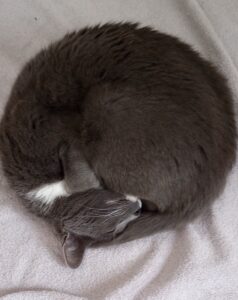
Although my cat Telemann hasn’t asked in so many words when we’re planning to return Truffle to the Ohio puppy mill from which he was rescued, I worry that, behind his stoical feline mask, he may be thinking just that. After our Cavalier, Bisou, died, Telemann reigned supreme in the house. Having sworn never to get another dog, I poured all my energies into enhancing his quality of life. I brushed him every day after breakfast. I waved a catnip-saturated fuzzy ribbon in front of him until he begged for mercy. And every night, as I lay in bed trying to read on my Kindle, he would arrange himself on my chest, gazing into my eyes and purring until I put down the screen and gazed back. What with the purring and the gazing, after a few minutes I would feel myself pulled into a strange inter-species abyss in which I could barely tell which of us was the cat, and which the human.
(A friend to whom I described these sessions said they reminded him of Martin Buber’s concept of the I-Thou encounter—a direct, mutual, and whole relationship where one meets the other as a unique being rather than an object, with no other goal than the relationship itself. [wording by A.I.])
But it took less than three months for my dog lust to conquer my better judgment, and Telemann found himself sharing his home with not just a dog, but one so needy and pathetic that he monopolized my days and and sapped my energies. It was all I could do to keep Telemann fed and his litterbox clean. Gone were the daily brushings and the play sessions. All non-essential services were suspended as I devoted myself to the diminutive intruder.
At Telemann’s insistence, however, the nightly I-Thou sessions continued. With Truffle tucked safely away in his crate, Telemann would jump up on the bed, position himself on my chest until his nose was practically touching mine, and the gazing would begin. I assume that when Buber philosophized about I-Thou encounters, he had humans in mind. But if you have ever tried to maintain prolonged eye contact with another person, you know that after a minute or so you are irresistibly tempted to either fall into each other’s arms or else dissolve into giggles. At least, that’s what happens to me. With a cat, however, it’s different. It may have to do with the inscrutability of the feline face (feline bodies, on the other hand, are anything but inscrutable), but whatever the reason, Telemann and I would hold each other’s gaze until his purring slowed, his eyes began to shut, and I turned off the light.
According to my vet, a cat’s home environment profoundly affects his digestion. Cats should be able to interact with their humans in the absence of stress or hurry, or their stomach function suffers. Clearly Telemann, with the instinctive wisdom of his species, was compensating for the hurry and stress caused by Truffle’s presence by insisting on our nightly I-Thou encounters.
A year after Truffle joined us, I am happy to say that things are finally settling down. Truffle has gained confidence, and learned that life can be fun. All by himself (my attempts to train him being useless in this respect) he now chooses to poop on the pee pad. There is still progress to be made in his socialization with human strangers and his urinary habits. But on the whole we have a system that, with the aid of pee pads, belly bands, and tons of positive reinforcement, works fairly well. I am slowly regaining the five pounds I lost in the two weeks after Truffle came. He and Telemann alternate between peaceful snoozes side by side and momentary but explosive spats brought on by failures in interspecies communication: dog makes play bows at cat, cat responds by jumping on dog, dog scares cat off with fierce but toothless growls.
The night, however, still belongs to Telemann. He asserts the right to I-Thou me on a regular basis, and his digestion, I’m pleased to report, is excellent. In this season of fear and loathing, if I can look into another creature’s eyes and feel that we are both at peace for a few moments, that is not a small consolation.
6 Responses
Took a while – now everyone knows they belong. Sweet!
I’m glad you understand your companions so well – and they get you.
Patience finally rewarded!
Buber had at least some I-Thou experience with his cat: “Sometimes I looked into a cat’s eyes. The animal’s glance rose in its greatness – and set at once. My own glance was more lasting. The world of It surrounded the animal and myself, but for the space of a glance the world of Thou had shone out from the depths, then to be extinguished and put back into the world of It.” Clearly, you and Telemann do it more fully than Buber and his cat did, though they had a glimpse of how it worked. Good on ya.
Love the world of It vs. the world of Thou. Thank you! Do you happen to know Buber’s cat’s name?
Regrettably, according to DeepSeek (one of my primary AI sources) “Many biographies center on a person’s public work and ideas. The name of a family pet, unless it played a documented role in public life, might not be recorded in major biographical sources.” Stuffy.
sigh…